
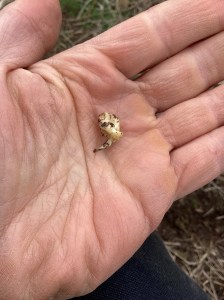
Upon inspecting my first sowings for this year, it seems a good amount have failed to germinate for a couple of reasons. The wheat seed I was using was older, and stored in a warmer environment. I believe this led to very low germination; maybe 1% in a controlled germ test. Other seeds were either saved or purchased in 2022, and of good quality. These were still slow to germinate in the cold soil, and eaten by some soil dwelling organism (slugs?). I underestimated how important fast emergence is when direct sowing.
After thinking and researching for a while, I’ve landed on some strategies to try and improve future sowings. The first is obvious: use seed of known quality. Avoiding seed eating organisms may prove to be more difficult. Improving the speed of seedling emergence may help to outpace seed eaters. Sowing at the appropriate time helps with this, and it is something I’m still learning for each crop in our region. I believe my March sowings were on the early side, and I plan to do my next sowing of peas, wheat, barley, and oats in early April. I also see potential in seed priming, which should help to speed germination in the field and get seedlings up and growing before the they get eaten.
My efforts haven’t been entirely in vain. The handful of barley and oat seedlings I started as transplants show the most promise for creating a uniform stand of healthy plants. These were planted in the field recently and seem to be off to a good start. Unfortunately, scaling this would require some nursery infrastructure that I’m just not able to create right now. In the future I may be growing nursery beds of grains to transplant to the field. By my calculations a 20’x4’ nursery bed could produce enough grain seedlings to grow 250lb of wheat, barley, or oats. Now, how much time it will take to transplant 7500 seedlings might make this entire idea impractical.
 Vashon Potato Project
Leave a comment